
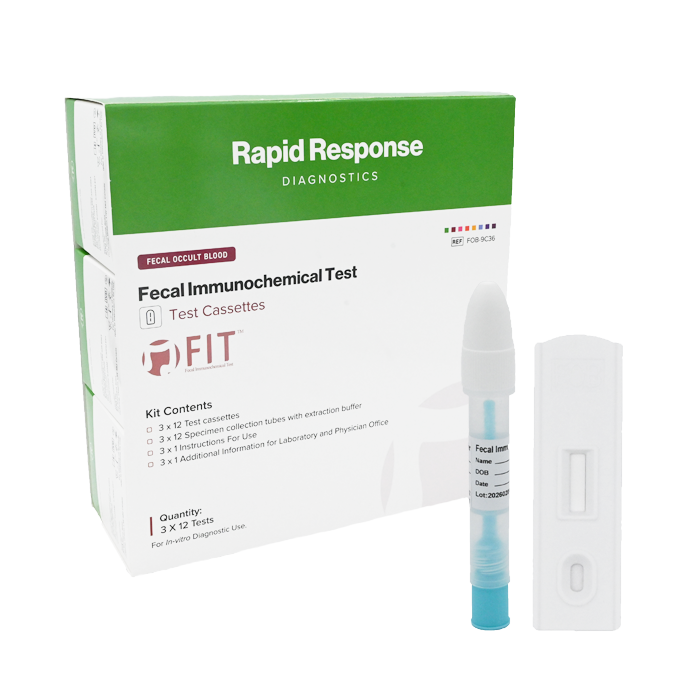


The Rapid Response™ Fecal Immunochemical Test (FIT) is a rapid chromatographic immunoassay for the qualitative detection of human occult blood in human fecal specimens, which may be an early indication of gastrointestinal problems such as colorectal cancer, ulcers, polyps or other gastrointestinal problems.
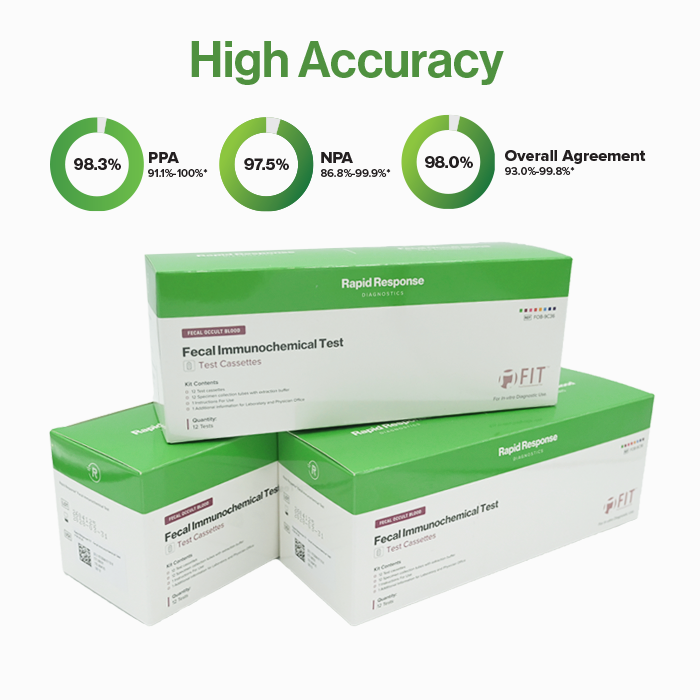
The Rapid Response™ FIT requires no dietary or medication restrictions prior to use and delivers an overall accuracy of 98.0%. This represents a significant advancement over traditional guaiac-based fecal occult blood tests, which are limited by lower sensitivity and specificity and require dietary restrictions before testing.
Offer your patients a more convenient, highly accurate screening solution, without the need for a lab visit, with the Rapid Response™ FIT.
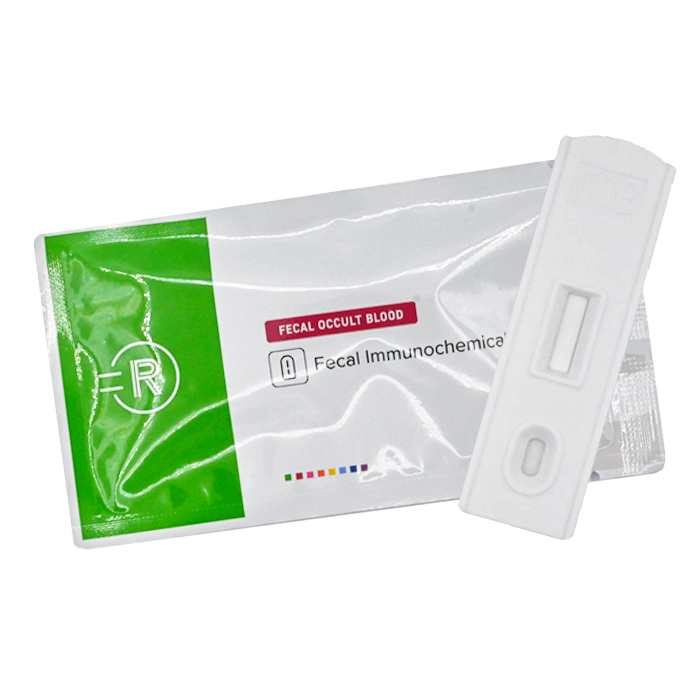
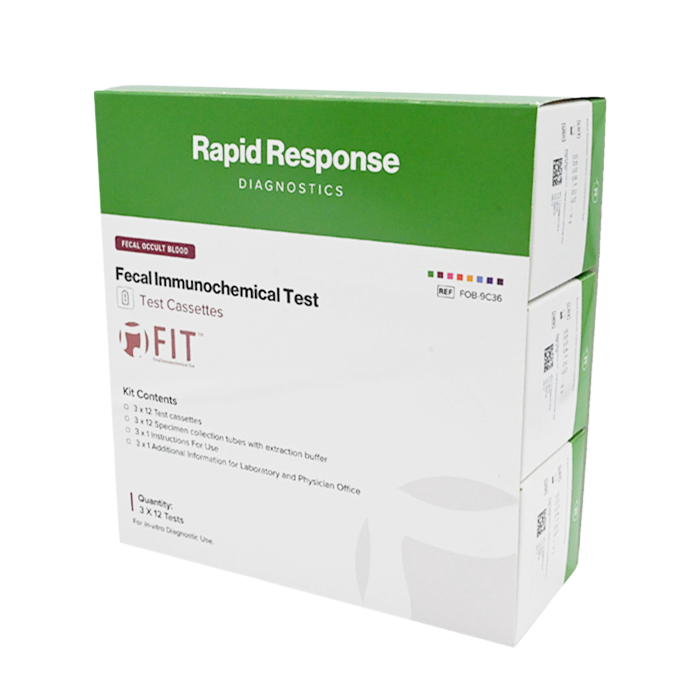
- 12 Individual pouches each with a test cassette per box (Kit contains 3 boxes)
- 12 Specimen collection tubes with extraction buffer per box (Kit contains 3 boxes)
- Product Insert
The Rapid Response™ Fecal Immunochemical Test (FIT) is a rapid chromatographic immunoassay for the qualitative detection of human occult blood in human fecal specimens, which may be an early indication of gastrointestinal problems such as colorectal cancer, ulcers, polyps or other gastrointestinal problems.
The Rapid Response™ FIT requires no dietary or medication restrictions prior to use and delivers an overall accuracy of 98.0%. This represents a significant advancement over traditional guaiac-based fecal occult blood tests, which are limited by lower sensitivity and specificity and require dietary restrictions before testing.
Offer your patients a more convenient, highly accurate screening solution, without the need for a lab visit, with the Rapid Response™ FIT.
No lab visit required for testing.
Accuracy not affected by diet - No fasting required
Aids in the early detection of colorectal cancer
Annual testing recomended by the CDC for adults 45+
Gastrointestinal diseases may cause occult (hidden) blood in stool. In the early stages, gastrointestinal problems such as colon cancer, ulcers, polyps, colitis, diverticulitis, and fissures may not show any visible symptoms, only occult blood. Traditional quaiac-based method lacks sensitivity and specificity to test for fecal occult blood and has diet-restriction prior to the testing.
The Rapid Response™ Fecal Immunochemical Test is a rapid test to qualitatively detect low levels of fecal occult blood in feces. The test uses double antibody sandwich assay to selectively detect as low as 50 ng/mL of hemoglobin or 6 µG hemoglobin/g feces. In addition, unlike the guaiac assays, the accuracy of the test is not a ected by the diet of the patients.
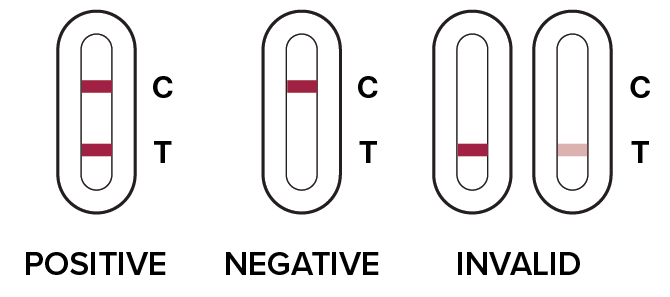
Please refer to the product insert for more details.

The BTNX Rapid Response Tests undergo regular evaluation using proficiency samples from AAB (American Association of Bioanalysts) and CAP (College of American Pathologists).
The BTNX Rapid Response® Fecal Immunochemical Test is a rapid, qualitative test used to detect human occult blood in fecal samples. It can help support the early detection of gastrointestinal concerns, including colorectal cancer or gastrointestinal bleeding from other sources. The test is intended for in vitro diagnostic use only
A fecal immunochemical test, or FIT, screens for hidden blood in stool using antibodies. Hidden blood can be a sign of colorectal cancer, polyps, or other gastrointestinal bleeding, but a FIT result alone does not diagnose cancer. The CDC notes that a positive or abnormal stool-based screening test should be followed by colonoscopy to complete the screening process.
FIT uses antibodies to detect human hemoglobin in stool, while guaiac-based tests use a chemical reaction to detect blood. BTNX notes that, unlike guaiac assays, the accuracy of the Rapid Response® Fecal Immunochemical Test is not affected by the patient’s diet.
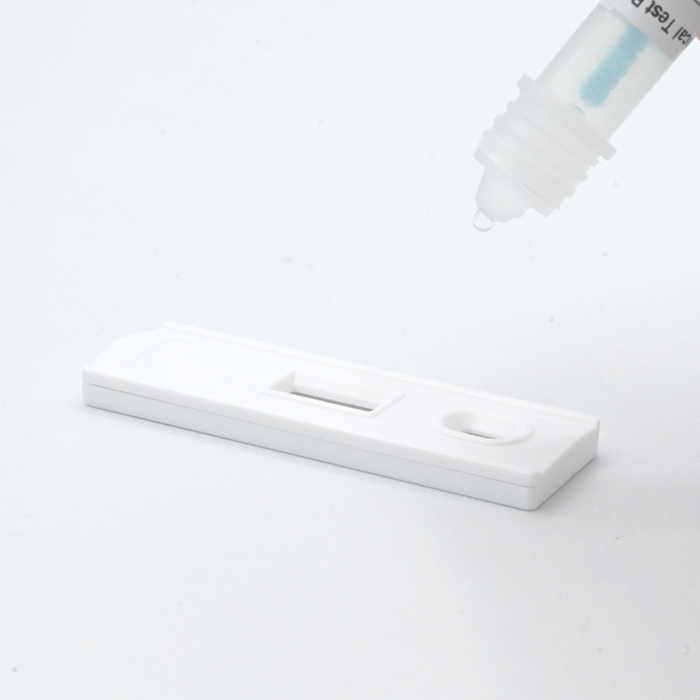
The BTNX Rapid Response® Fecal Immunochemical Test provides results in 5 minutes. The product is a cassette-format lateral flow immunoassay with a listed sensitivity of 50 ng/mL, or 6 μg/g, and specificity for human hemoglobin.
Most people should begin colorectal cancer screening soon after turning 45, according to CDC guidance based on U.S. Preventive Services Task Force recommendations. People with a personal or family history of colorectal cancer or polyps, inflammatory bowel disease, or certain genetic syndromes should speak with a healthcare professional about whether they need screening earlier or more often.
Screening for Colorectal Cancer | Colorectal Cancer | CDC
- Simon J.B. Occult Blood Screening for Colorectal Carcinoma: A Critical Review, Gastroenterology, Vol. 88: 820. 1985.
- Blebea J. and McPherson RA. False-Positive Guaiac Testing With Iodine, Arch, Pathol, Lab, Med. 1985;109:437-40
- Please note that certain products may only be available in specific regions; kindly consult with a sales representative for further information regarding product availability.
- The information provided on this website is for educational purposes only and should not be construed as medical advice. Always consult with a qualified healthcare professional regarding any medical concerns or conditions.
- Our products are intended for use as specified in the product documentation. It is important to carefully read and follow all instructions provided with the product.